Website Structure for AI Search
What Matters in 2026

TL;DR
- In 2026 your website structure is read not only by visitors and Google, but also by generative AI tools such as AI Overviews, ChatGPT, Perplexity and Gemini.
- The old rule of three menu levels and three clicks to a product is no longer enough. You now need visual, semantic and information hierarchy at the same time.
- AI tools scan a page, pull out one specific sentence and use it as a source. If your content gives no clear answer for each segment, it will not be quoted.
- Four common mistakes: near duplicate subpages competing for the same keyword, a menu built around your internal organisation, neglected internal links, and weak URLs with unclear headings.
- We build develop on our own KabiCloud platform, so the structure follows the client's business model and the editor can change it without a developer.
- First steps: review how visitors behave, check how AI tools describe you, then decide between a smaller structural change and a full redesign.
When a business owner thinks about website structure, they usually think about the menu, the hierarchy of subpages and the navigation. Until last year that was enough. In 2026 the picture is different. Your content is no longer read only by a visitor. It is also read by Google's AI search, ChatGPT, Claude, Perplexity and others. Every one of them has to understand how your website is organised. If the structure is not clear, you cannot count on visitors finding you.
We have been developing websites for Slovenian and international companies for more than 30 years, and in that time we have learnt what a sound structure looks like. The design of the site matters less than the way the information on it is presented. Below we explain what website structure has to look like in the age of AI search.
Why three menu levels are no longer enough
The rule that shaped website development for a decade was simple. No more than three menu levels, a clear hierarchy, and a path to every product in three clicks. It came from a time when visitors typed keywords into Google and clicked one of the blue links on the results page. Today the visitor often never reaches your menu. They ask an AI instead. The AI first has to understand your content, pull out an answer, and only then send the visitor to the right subpage.
Structure is therefore no longer only a help to people. It is also a help to the machines that read your site. This is the point where classic search engine optimisation extends into generative engine optimisation, or GEO.
The three structures you now need to separate
For a modern website we separate three overlapping structures. They have to work together.
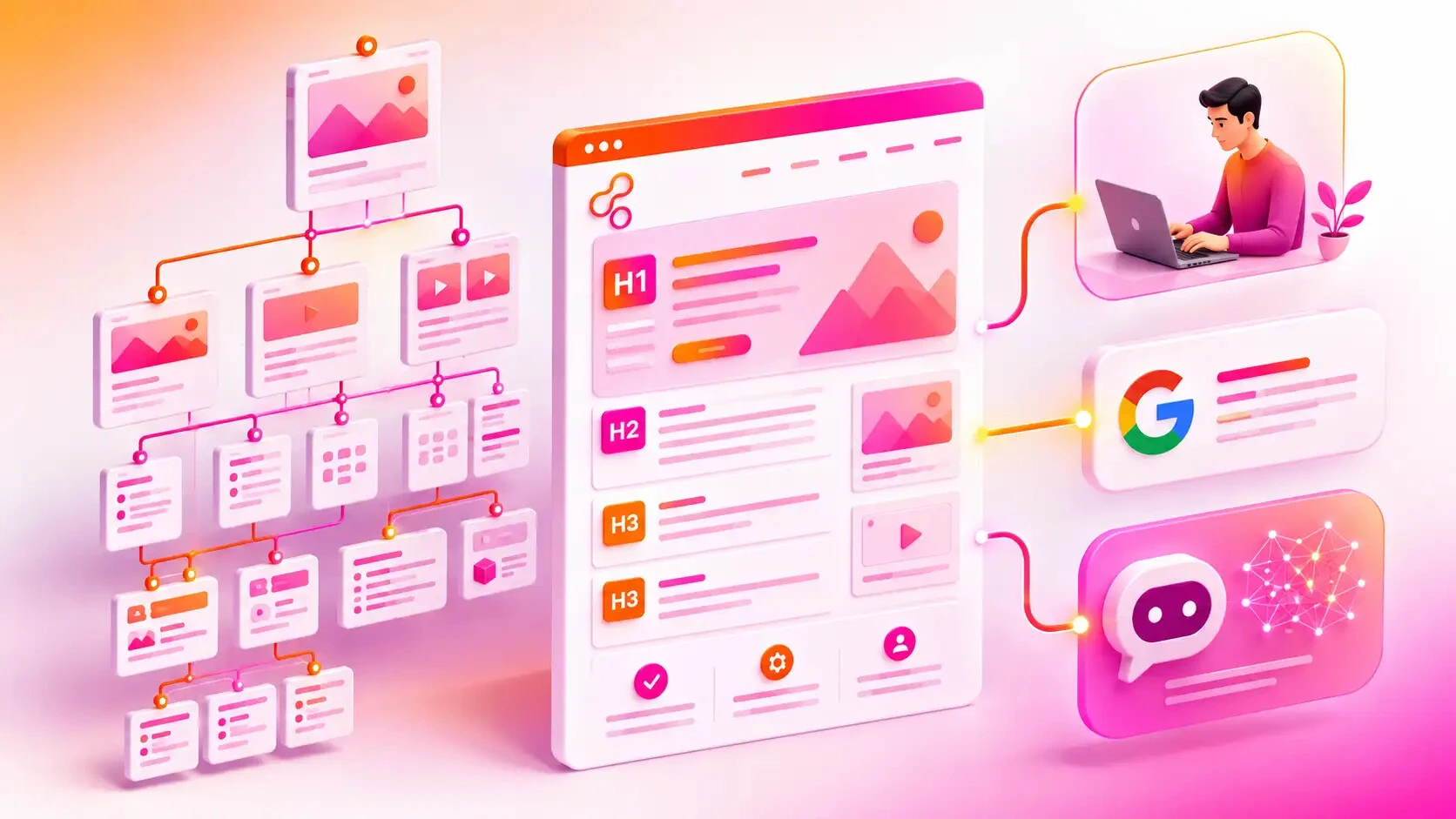
- Visual hierarchy. The menu, header, footer, buttons and colour scheme that tell a visitor where they are and where they can go next. A structure that relies on this alone is incomplete for the current web.
- Semantic hierarchy. Headings from H1 to H6, alt attributes, clear URLs and the labels that say what a subpage actually is. This is the level that search engines and AI tools use when they decide which content best matches what the user is looking for.
- Information structure. The way you connect content together. Which subpage refers to which, which topics you group into clusters, and how you build topical authority with them.
How AI search engines read your pages
When AI tools look for an answer, they do not read your page from top to bottom. They scan the main labels, find the pattern, look for one specific sentence and use it as a quotation. If your main information is hidden in small print, or wrapped in marketing language with no concrete answer, the AI will not find you. In practice this means that every segment of the page has to answer a question clearly.
Google's official guidance on search optimisation makes the same point, and our own work confirms it. The structure we recommend starts from clear topic clusters, short introductory summaries, and subpages that complement each other in a logical way.
An example from our work
A distributor of air conditioning units and heat pumps had 350 subpages before the redesign. The menu followed the company's internal logic: brand, news, about us, servicing and so on. Google understood that they were a distributor of air conditioning units, but AI tools left them out of specific questions such as "which air conditioning unit should I choose for an office". After the redesign we rebuilt the structure around the visitor's intention: products by intended use, a clearer structure, more information, use cases, servicing and so on. Each of these branches has its own topic cluster. The result after six months was 30% growth in organic traffic from Google, the first mentions in AI Overviews results, and twice as many enquiries from the website.
Where structure usually breaks down
In practice we see four mistakes again and again.
- Too many similar subpages that compete with each other for the same keyword.
- A menu that reflects the internal organisation of the company instead of how buyers search.
- Neglected internal links between related articles and subpages.
- Weak URLs and missing clear headings, which make it hard for a search engine or an AI tool to understand the content quickly.
What we do differently at Kabi
We develop every website on our own KabiCloud platform, which means we are not limited by the themes or plugins of other systems. We adapt the structure to the client's business model, not the other way round. On every website development or web shop development project we start from topic clusters that we plan together with the client. Structure is the first step. SEO Optimization services and continuous content development follow.
It is just as important that the owner of the site can maintain the structure without help. In CMS Bananadmin, our own content management system, an editor can add a new topic branch, move a subpage or refresh internal links without a developer. We follow the same logic in Kabi CRM, our own CRM platform, where an ordered data structure is the precondition for the sales process to work at all.
Where to start if your structure feels dated
The first step is to look at how visitors actually behave. Where they enter, where they leave, and which subpages they never reach. Web analytics will tell you this. The second step is to check how AI search tools describe you. The third is to decide whether you need a smaller change to the structure or a full redesign of the site.
Rebuilding the structure is not cosmetic work. It is a strategic decision that has a direct effect on how well the website performs, sometimes it is beeter to do the whole website redesign. In an age when people search through AI, your structure is in effect your first salesperson. Make sure it can answer.
Maybe you are interested
Read more