Dali: The Kabi Chatbot That Answers Your Website Visitors Instead of Menus and Filters

TL;DR summary
Dali is a chatbot that answers your website visitor's question instead of making them browse through menus and filters. It answers exclusively from your data, meaning your content, products, prices, or properties, and never makes anything up. The language model runs on our servers, so your visitors' questions are never sent to OpenAI, Google, or anywhere else abroad. On the Nepremičnine Si21 portal, it handled more than 1,000 conversations in the first few days without any advertising. Chat inquiries go into your Kabi CRM, and support requests go into the Support module.
Introduction
Visitors to your website usually know what they're looking for. The problem is they often can't find it quickly enough.
Menus, categories, filters, and search fields make perfect sense to us, since we develop websites and web shops. For the average visitor, though, they can sometimes be overly complicated. Instead of clicking through five subpages or filling in filters, they'd rather simply ask, the way they would ask over the phone or during a visit to your store or office.
That's exactly what we've now made possible with our Kabi Chatbot Dali, which we present below.
Dali on the real estate portal
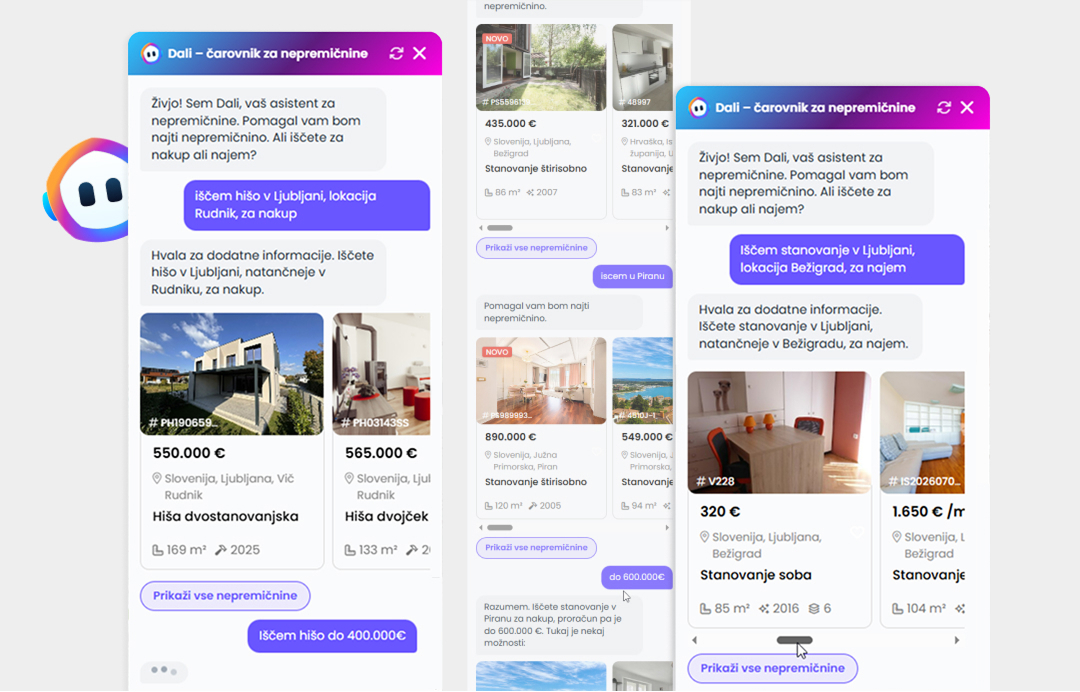
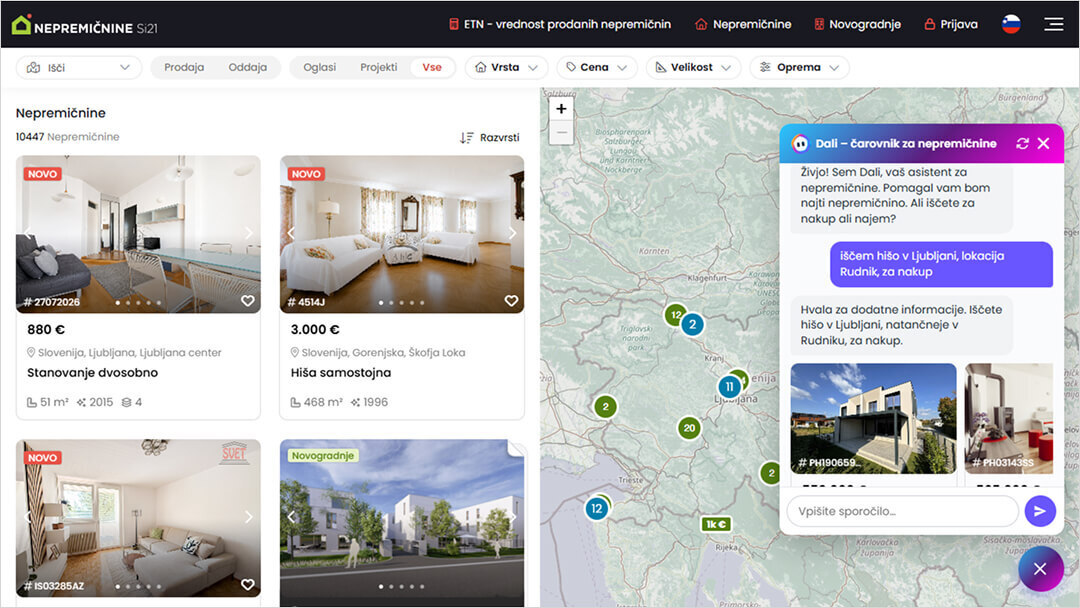
On the Nepremičnine Si21 portal, we launched a conversational assistant, or chatbot named Dali. The visitor tells it what they're looking for. For example: "I'm looking for a house in Ljubljana, Rudnik area." Dali immediately finds the matching properties from the database and displays them with photos, prices, and a link to the listing.
No forms to fill out. No guessing which category the property they're looking for belongs to.
The response exceeded our expectations. In the first five days after launch, the chatbot completed more than 2,000 conversations with just as many different visitors. We didn't advertise it and didn't specifically draw attention to it. Visitors noticed it themselves and tried it out.
That number confirms something we'd long suspected from traffic analysis. People don't want to browse a website, they want to get an answer. When you offer them a path shorter than the menu, they'll increasingly choose it.
Not just for online stores
Mention the word chatbot and most people first think of product search. That's just one use case.
On presentation websites, Dali answers visitor questions about your services, terms of cooperation, your offering for a particular industry, or who to contact. Instead of the visitor browsing through subpages and leaving because they couldn't find an answer, they get one immediately. Companies with extensive service catalogs, frequently asked questions, multiple branches, or a lot of expert content benefit from this just as much as stores do.
In an online store, Dali guides the visitor to the right product. The larger the catalog, the more valuable it becomes. Within moments it searches through the entire offering, even if it spans tens of thousands or several hundred thousand products. If you've ever wondered why your online sales aren't performing as well as they could, understanding your market is often the missing piece, and the inability to quickly find the right product is one of the more common reasons. The path to the product matters as much as the product itself.
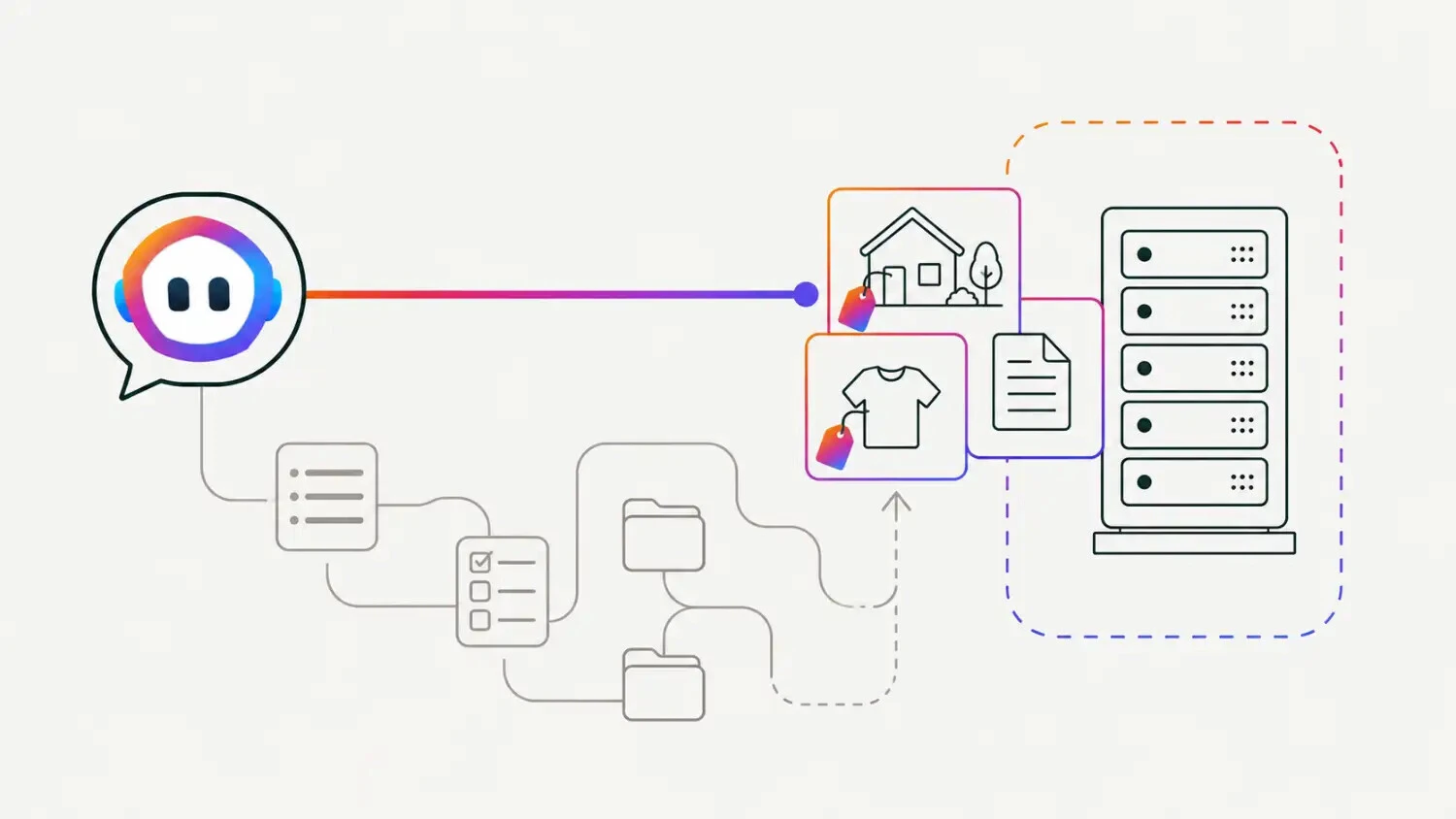
We connect the chatbot to your content, product data, or service data. What exactly it will know is agreed upon and configured individually for each client.
What does Dali do differently from typical chatbots?
It answers exclusively from your data
Dali doesn't make up answers. It only knows what's in your database: your content, your services, your products, your prices, your properties, your vehicles. Think of it as a new colleague who's been thoroughly trained on your business and never promises anything you don't actually offer.
The difference matters more than it might seem at first glance. General-purpose chatbots often say things you never promised. That's already come back to bite plenty of companies in the form of complaints. Dali doesn't do this, because it simply doesn't know anything other than your data.
It can't be misused for other purposes
Some companies have found that visitors use their chatbot to write homework assignments, marketing copy, or generate images. Dali sticks to the task it's been assigned. If someone asks it for a recipe or a poem, it will politely redirect them back to your offering.
Your chatbot therefore stays your chatbot, and doesn't turn into a free tool for anonymous visitors.
Your data stays with you
This is probably the most important advantage. Behind the scenes we use a local language model that runs on our own servers, dedicated exclusively to this service.
Your data and user questions are never sent to OpenAI ChatGPT, Google Gemini, Claude, or any other external service. They are not used to train foreign models. They don't travel halfway around the world (outside the EU) and back.
To put it simply: the difference is the same as keeping your business records in your own safe, versus sending a copy abroad every day to someone who promises they won't read it.
For you, this also means less paperwork. There's no new subprocessor in your privacy policy, no data processing agreement with a US provider, and no need to assess data transfers to a third country. We've written before about correct and incorrect use of artificial intelligence. The same goes for the broader question of how much dependence on foreign providers European companies can still afford.
It works 24 hours a day
Visitors show up in the evenings, on weekends, and during holidays. Dali answers even when you're not at your computer, guiding the visitor to an answer or a product exactly when they need it.
It speaks your customers' language
The chatbot currently operates in Slovenian, but we can easily train it for other languages as well. If you do business outside Slovenia, your visitors can communicate in their own language, and you're no longer dependent on whether someone on your team happens to speak it at that moment.
It shows you what your customers are looking for
Every conversation is a window into how your customers think. You see what they're asking, the words they use to describe it, and what might be completely missing from your offering or website. That's valuable information for purchasing, marketing, and website content strategy. The fact that twenty people asked about a product you don't carry in a single week is worth more than many market surveys.
In doing so, the chatbot doesn't collect any personal data about visitors. It doesn't require login, doesn't log identities, and doesn't build profiles of individuals. A visitor can ask anything without leaving a trace behind, while you only see what's being searched for on your site. For your visitors, that means fewer hesitations, and for you, one less worry about personal data protection.
Four ways to get a chatbot, and how they differ
Today you can get a chatbot in several ways. They all work. They differ in where they run, what they're connected to, and who you call when something isn't working.
| Kabi (Dali) | Standalone Slovenian provider | European platform | Non-EU provider | |
|---|---|---|---|---|
| Where the language model runs | On our own hardware/servers | At a foreign provider | At a foreign provider | At a foreign provider |
| Data transfer outside the EU | No | Usually yes | Usually no | Yes |
| Installation | Already built into your site | Embed code | Embed code | Embed code |
| Refresh on content change | Automatic | Manual or occasional | Manual | Occasional |
| Products, properties, vehicles in chat | From your database | No | No | No |
| Where inquiries go | Into your CRM | To email | Into their system | Into their system |
| Where support requests go | Into your Kabi support | To email | Into their system | Into their system |
| Payment model | Fixed per website | Per response | Per user | Per user |
| Who you call when there's a problem | Us, as always | A separate provider | English-language support | English-language support |
The "payment model" row is the one clients often overlook. Since we don't pay a foreign interface for each individual response, we don't charge based on the number of messages sent or users. A well-visited month on your site doesn't mean a higher bill.
When might another provider serve you better?
We won't pretend we're the right choice in every case.
If you need a chatbot on a website we don't host, we can't help you. Ours only works on sites that run on our infrastructure.
Dali covers your website. If you want the same tool to also answer on WhatsApp, Instagram, and by phone, you'll need an additional platform for those channels. Requests that come in through the website chat, however, are picked up by the Support module in Kabi CRM, where they're assigned an owner, a deadline, and a status. A question Dali can't answer doesn't get stuck in an inbox, it reaches a person who can resolve it.
How does this connect with other digitalization systems?
Dali isn't a standalone tool bolted onto a website. It's part of our website building platform and online store platform, so it knows what's on your site and refreshes whenever you update the content.
Because it's also connected to the Kabi CRM system, an inquiry from the chat doesn't end up in a foreign inbox, it lands in your sales process, where someone picks it up. If it's a request from an existing customer, the same system routes it to the Support module. Sales and support therefore work from the same data about the same customer. For real estate agencies using our real estate websites, this means chat and property listings work off the same data. We wrote last year, back when it was still just an announcement, about how artificial intelligence is taking hold in real estate and online stores.
The impact on traffic is measurable in numbers you're probably already tracking. A visitor who finds what they're looking for doesn't leave the site after twenty seconds, which shows up in bounce rate and conversion numbers. There are also fewer phone calls and emails along the lines of "do you even offer this" and "do you have this in stock." If you're interested in the bigger picture, we recommend our article on how to plan the structure of a website.
How to get started?
The fastest way to find out whether a chatbot makes sense for your site is a short demo run on your actual content. We look at what Dali would answer your visitors, and where content needs to be filled in for it to answer well.
If you're wondering whether your website even stores the right data for this, start with the question of what clients often forget about their website. The answer is often the same as with the chatbot: the content the visitor is actually looking for is missing.
Maybe you are interested
Read more